1837
Francois and Joseph Blanc hijacked the French optical telegraph network by bribing operators to insert deliberate backspace/error codes into stock market transmissions. The scheme ran for roughly two years before being exposed in 1836, making it the first documented attack combining an insider, a covert channel, and a financial network.
1844
Samuel Morse transmitted the first message ("What hath God wrought") over the Baltimore–Washington line on May 24, 1844, exposing physical wiretapping along unencrypted DC lines almost immediately.
1876
Alexander Graham Bell was granted US Patent 174,465 for the telephone, introducing analog voice circuits that immediately opened new attack surfaces for inductive and galvanic eavesdropping.
1891
Undertaker Almon Strowger patented the first automated stepping switch after suspecting manual telephone operators were diverting his business calls to a competing undertaker.
1903
Illusionist and wireless pioneer Nevil Maskelyne intercepted and injected sarcastic Morse code insulting Guglielmo Marconi during a live demonstration at the Royal Institution in London, proving that open radio channels lacked origin authentication.
1918
On 23 February 1918, German engineer Arthur Scherbius filed a patent for a rotor cipher machine that became the Enigma, marketed from 1923 by Chiffriermaschinen AG to businesses for enciphering written and telegraphic messages before transmission.
1957
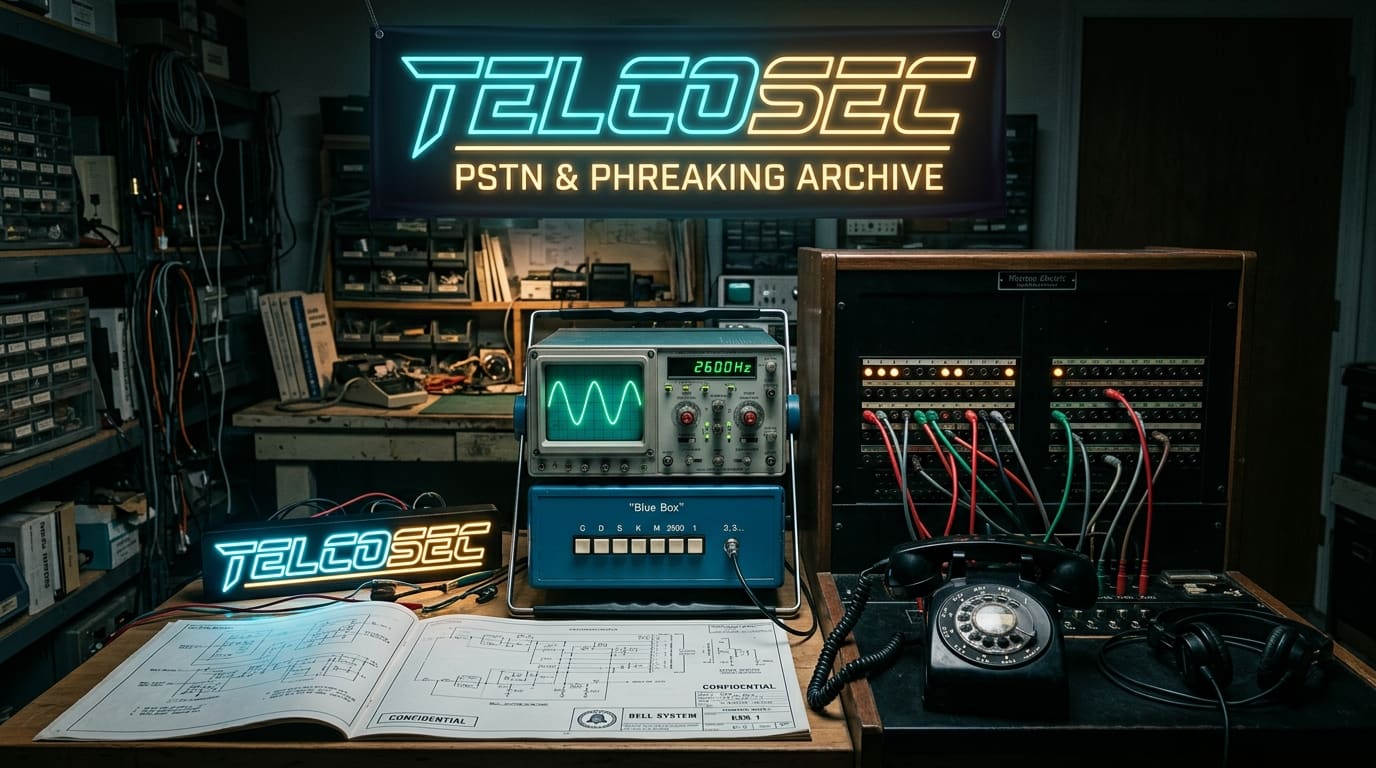
Seven-year-old blind boy Joe Engressia discovered that whistling an exact 2600 Hz pitch into a receiver reset AT&T toll trunk lines, founding the phone-phreaking movement.
1964
John Draper ("Captain Crunch"), Steve Wozniak, Steve Jobs and others built Blue Boxes that emitted 2600 Hz plus MF digit tones to make free global calls, industrializing the SF signaling flaw.
1971
Ron Rosenbaum published 'Secrets of the Little Blue Box' in Esquire, exposing the technical mechanics of 2600 Hz phone phreaking, Captain Crunch, and homebrew Blue Box construction to a global audience.
1978
Phreakers engineered specialized Red Boxes simulating payphone coin drop frequencies (1700 Hz + 2200 Hz) and Silver Boxes with modified DTMF keypads to seize military Autovon priority override circuits.
1984
In January 1984, Eric Corley (writing as "Emmanuel Goldstein") and David Ruderman began publishing 2600: The Hacker Quarterly. The title refers to the 2600 Hz trunk-seizure tone, and the first issue appeared in the same month AT&T was broken up. Phrack followed on 17 November 1985, published on the St. Louis "Metal Shop" BBS.
1990
A single line of buggy C code in a 4ESS switch patch caused a cascading SS7 recovery storm on January 15, 1990, dropping roughly 60 million calls over nine hours.
1990
In 1990 US federal agents moved against the phreaking underground: Legion of Doom member Robert Riggs ("The Prophet") and Phrack editor Craig Neidorf ("Knight Lightning") were indicted over a stolen BellSouth E911 document, while the separate, Arizona-based Secret Service Operation Sundevil raided BBS operators in about a dozen cities on 7–9 May 1990.